
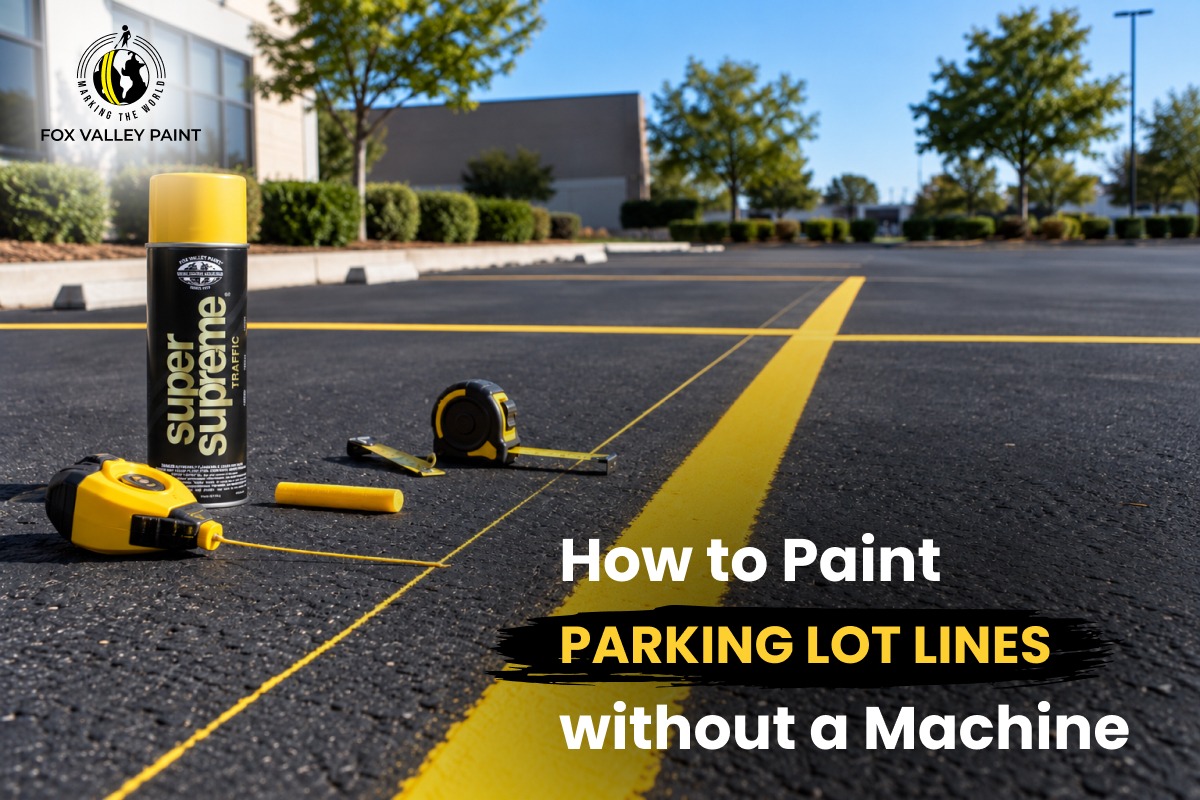
Learning how to paint parking lot lines without a machine is the most practical skill for small lot owners, property managers handling touch-up work, and anyone with a tight budget who needs a few stalls marked quickly. While a line striping machine delivers more consistent results on full lots, freehand aerosol application works well for jobs under 20 spaces, single-line corrections, and quick repairs. This 5-step guide covers everything you need to get clean, straight lines without any powered equipment.
Freehand aerosol painting is the right choice in some situations and the wrong one in others. Here is an honest breakdown before you start:
For anything larger, a line striping machine saves time, uses 20 to 30 percent less paint per pass, and delivers consistent 4-inch lines from the first stall to the last. For single-line corrections, see our guide on how to fix crooked parking lot lines.
The most critical item is quality traffic marking paint not hardware store aerosol. Traffic paint is formulated to bond to asphalt and concrete and lasts 12 to 24 months under vehicle traffic. General spray paint fades within weeks outdoors.
Clean the surface before touching anything else. Sweep away all debris, degrease oil spots, and allow the surface to dry completely. Wet or dirty asphalt prevents proper paint adhesion regardless of technique. Read the full surface prep guide before starting.
Then measure and mark your stall layout using standard dimensions. See our parking lot layout for striping guide for the full measuring and marking process.
This is the step that separates clean freehand lines from wavy drifting ones. Hook your chalk snap line at one end of the stall line and snap it across the full 18-foot length. The chalk line becomes your visual guide for the entire aerosol pass.
Mark the start and end point of each line with a chalk dot before snapping. Snap every line in the row before painting any of them so you can see the full layout and catch spacing errors while they are still in chalk.
Snap lines for the entire row before picking up a paint can. Walking the full chalk layout first lets you spot drift and spacing errors before any paint touches the surface.
Confirm air and surface temperature is between 50°F and 90°F before opening any can. No rain should be forecast for at least 2 hours after application. Painting outside this range causes flash drying, poor adhesion, and early peeling regardless of technique. Check the full spray striping paint temperature guide before starting.
Hold the can 12 to 14 inches above the surface and angle it slightly forward in the direction you are walking. Position the nozzle so the edge of the spray pattern falls directly on the chalk line on one side.
Move at a consistent walking pace of roughly 2 to 3 feet per second. Stopping mid-line creates a heavy blob. Walking too fast thins the coverage and leaves gaps. Practice your pace on a scrap piece of cardboard before touching the actual surface.
Keep your eyes on the chalk line 12 to 18 inches ahead of the nozzle rather than directly below it. This lets you steer ahead of any drift instead of reacting after it has already happened.
Quality aerosol traffic striping paint dries to the touch in under 10 minutes in ideal conditions and is vehicle-safe within one hour. Keep all foot and vehicle traffic completely off the painted area until fully dry. Do not test dryness by touching, the surface may feel dry before it has fully cured underneath.
Fox Valley’s professional-grade aerosol traffic striping paint bonds to asphalt and concrete in a single pass and stays bright for 12 to 24 months. Available in white, yellow, blue, red, and more. Not all aerosols are equal.
Place the spray pattern so one edge of the line follows the chalk exactly. Trying to center the spray on the chalk is harder to judge consistently and causes the line to wander left and right across the guide.
Place a piece of cardboard at the start and end of each line to create a clean cutoff. Freehand starts and stops produce ragged edges with overspray. A cardboard mask gives you a straight edge at both ends in seconds.
Walk the full line first with the can held but the cap on. Practice the pace, the distance from the chalk, and your body position. One dry run before the actual pass removes almost all uncertainty and wasted paint.
Paint all lines in one row completely before moving to the next. Jumping between rows breaks your rhythm and makes it harder to maintain consistent speed and distance between passes.
Freehand is a valid technique for small and temporary work. For any lot larger than 20 spaces, a recurring annual maintenance schedule, or a full professional result, a line striping machine holds the can at a fixed height on every pass producing consistent 4-inch lines from the first stall to the last while using 20 to 30 percent less paint per pass than freehand application. For most property owners doing freehand work today, the machine pays for itself within the first full repaint job in time savings and paint efficiency alone. See our parking lot paint calculator to see how much paint your lot requires.
Fox Valley’s Traffic Starter Kit includes a precision line striping machine and professional-grade traffic paint sized for lots up to 30 spaces. One kit, one order, straight lines on every pass.
Yes. With a chalk snap line as your guide you can paint straight lines freehand. The chalk gives you a visual edge to follow with the aerosol can. Without it, even slow careful passes drift off-angle by mid-line.
Use dedicated traffic striping paint, not hardware store spray paint. Traffic paint bonds to asphalt and concrete and lasts 12 to 24 months under vehicle traffic and UV exposure. General aerosol paint fades within weeks outdoors.
Hold the can 12 to 14 inches above the surface for a standard 4-inch line width. Lower distances produce a narrower heavier line. Higher distances produce overspray and a faded center that wears faster under traffic.
Each can of traffic striping paint covers approximately 150 to 200 linear feet at 4-inch width. Freehand application typically uses slightly more per line than machine application due to varying spray distance and angle.
The paint itself lasts equally long, typically 12 to 24 months. The difference is line consistency. A machine maintains exact height and angle on every pass. Freehand lines vary in width and thickness based on walking speed and distance, which affects how long the line stays visually sharp before appearing faded.