
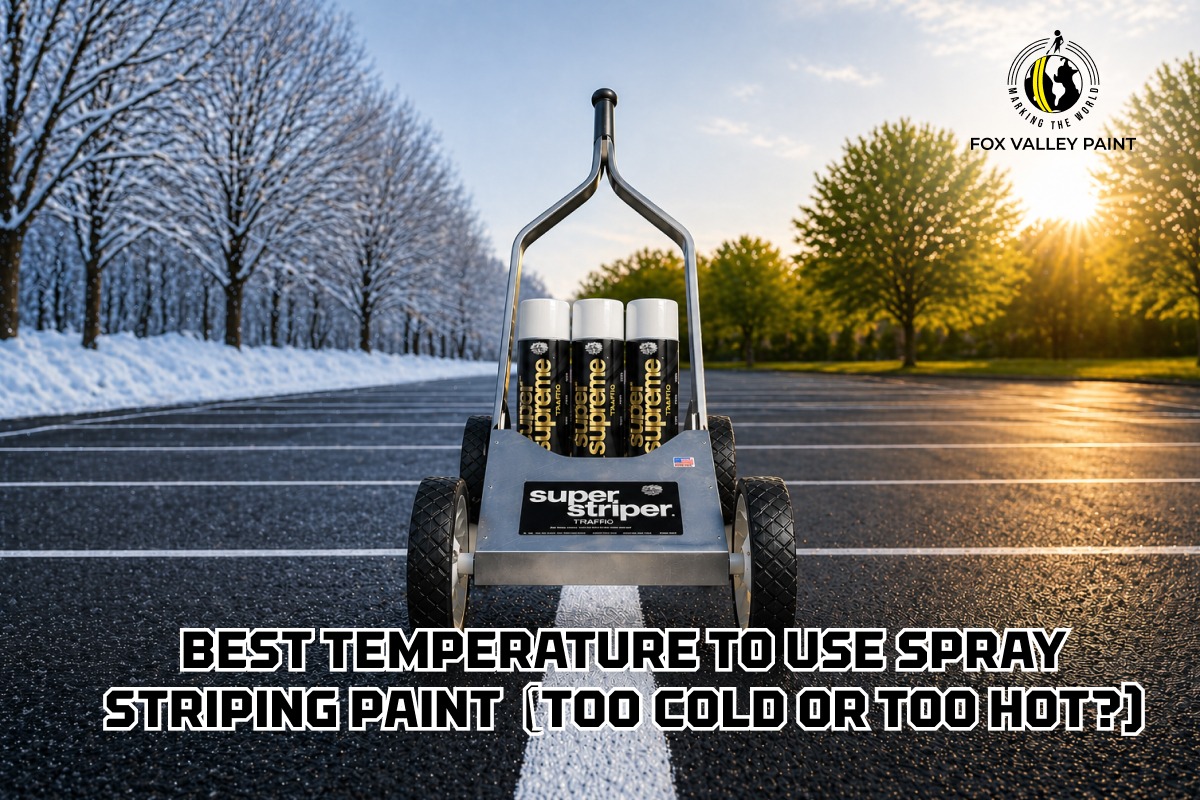
Spray striping paint temperature is the single biggest factor that determines whether your parking lot lines last for years or peel up in weeks. One question stops more DIY striping jobs than anything else: “Is it okay to spray today?”
The ideal spray striping paint temperature range for aerosol application is 50°F to 90°F (10°C to 32°C) for both the air and the pavement surface. Below 50°F, water-based paint will not bond properly. Above 95°F, it flash-dries too fast and creates uneven lines. Both the air temperature and the surface temperature must be within range.
Traffic striping paint is not like regular spray paint. It needs to bond into the pores of asphalt or concrete and cure into a film that holds up against vehicle tires, UV rays, and weather. Temperature controls every part of that process.
When the air is too cold, the water or solvent in the paint cannot evaporate fast enough. The paint stays wet and tacky for hours, picks up dirt, and never forms a hard film. When it is too hot, the paint dries before it has time to penetrate the surface, leaving a brittle coat that flakes early.
There is also a second temperature to watch: the pavement surface temperature. On a sunny day, asphalt can be 20 to 30 degrees hotter than the air. You can have a perfectly comfortable 75°F afternoon, but your black asphalt could be at 105°F, which is already pushing the upper safe limit.
| Condition | Air / Surface Temp | Status | What Happens |
|---|---|---|---|
| Ideal | 60°F – 85°F | STRIPE NOW | Clean adhesion, fast dry, crisp lines |
| Acceptable (cool) | 50°F – 59°F | PROCEED WITH CARE | Slow dry time; apply thin coats, wait longer between passes |
| Acceptable (warm) | 86°F – 95°F | STRIPE EARLY/LATE | Flash-drying risk; stripe before 9 AM or after 5 PM |
| Too Cold | Below 50°F | DO NOT STRIPE | Paint will not cure; lines peel within days |
| Too Hot | Above 95°F (surface) | DO NOT STRIPE | Flash-dries before bonding; uneven, brittle finish |
Water-based parking lot striping paint needs a minimum air and surface temperature of 50°F to cure correctly. Below that, the water in the formula cannot evaporate. The paint film stays soft, picks up tire marks immediately, and may never fully harden.
If you must stripe in cooler weather, check whether your product is a solvent-based formula. Solvent-based and acetone-based traffic marking paints can perform at temperatures as low as 40°F because they do not rely on water evaporation to cure. Fox Valley’s aerosol formulas are designed for real-world conditions always check the can label for the minimum listed temperature.
Fox Valley’s Traffic Starter Kit includes everything you need: high-performance aerosol paint and a precision striping machine designed to work in real outdoor conditions.
High temperatures create the opposite problem. When the aerosol striping paint hits a surface that is 100°F or hotter, the outer layer of the paint dries almost instantly. That dried skin traps solvents underneath, which leads to bubbling, poor adhesion, and lines that look faded or uneven within weeks.
The fix for hot-weather striping is straightforward: work in the early morning or evening when the pavement has cooled. Even on a 95°F summer day, asphalt that has been in shade or out of sun for a few hours can be perfectly acceptable to stripe.
Temperature alone does not tell the whole story. High humidity (above 85%) slows the evaporation of water-based paint in the same way cold does. Even on a warm 70°F day with 90% humidity, your lines may take far longer to dry and could look milky or dull when cured.
The ideal combination for any field marking paint or traffic paint application is 60–85°F with humidity below 85%. Most spring and fall mornings hit this window naturally, which is why experienced stripers consider those the best seasons to work.
Before you load your striping machine and start a job, run through these four checks:
If all four boxes check out, you are good to go. If even one fails, the risk of poor results is real and re-striping costs more time and money than waiting one day.
Fox Valley’s aerosol striping paints are formulated for professional results in real outdoor conditions. Whether it’s a parking lot, soccer field, or baseball diamond we have the paint and the machine for the job.
For water-based aerosol striping paint, the minimum safe application temperature is 50°F (10°C) for both the air and the pavement surface. Solvent-based formulas can go as low as 40°F in some cases. Always confirm the specific minimum on your product's label.
Yes, but only if the pavement surface temperature is below 95°F. On very hot days, stripe in the early morning or after 5 PM when the asphalt has cooled. Applying paint to a surface above 95°F causes flash-drying and poor adhesion.
Yes. Humidity above 85% slows the drying of water-based paints, similar to cold temperatures. Ideal conditions are below 85% humidity combined with an air temperature between 60°F and 85°F.
If rain falls within 30 to 60 minutes of application before the paint has dried, it can wash away or mottle the lines. Most aerosol striping paints are touch-dry in 10 to 20 minutes, but a full cure that can resist rain takes at least 1 hour. Do not stripe if rain is expected within that window.
Both work well in summer. Early morning (before 9 AM) is ideal because pavement has cooled overnight. Late afternoon (after 5 PM) works once direct sunlight is no longer heating the surface. Avoid mid-day striping during hot months when asphalt temperatures peak.