
Parking lot striping paint on concrete is one of the most common questions from property owners with concrete driveways, parking decks, warehouse floors, and mixed-surface lots. The straightforward answer is yes, professional-grade traffic striping paint bonds to concrete just as effectively as it bonds to asphalt, with some important differences in surface preparation and application technique. This guide covers everything you need to stripe concrete successfully and make the results last.
Short answer: Yes. Professional-grade traffic striping paint is formulated to bond to both asphalt and concrete. The key difference is not the paint, it is the surface preparation. Concrete requires a slightly different prep process to achieve the same adhesion quality and line longevity as asphalt.
Understanding these surface differences helps you apply the right technique and avoid the most common concrete striping failures:
According to the Federal Highway Administration pavement marking standards, traffic markings must maintain retroreflectivity and visibility regardless of surface material. This applies equally to concrete and asphalt lots open to the public.
Prep is more critical on concrete than on asphalt. One step, checking for existing sealers, is unique to concrete and is the most common cause of paint failure on concrete lots. Here is how the two prep processes compare:
| Prep Step | Asphalt | Concrete |
|---|---|---|
| Minimum cure time | 30 days (new surface) | 28 days minimum |
| Cleaning | Sweep + degrease oil spots | Sweep + heavy degrease + rinse |
| Sealer check | Not typically needed | Required remove any sealer first |
| Moisture dry time | 24 hours after rain | 24 to 48 hours concrete holds moisture longer |
| Surface texture | Standard rough texture | Confirm no polished or sealed areas |
The most important step unique to concrete is confirming no existing sealers or coatings are present. Sealed concrete repels paint the same way a waxed car repels water. Do the water bead test: sprinkle water on several spots. If water beads and does not absorb, a sealer is present and must be removed before striping. See the full parking lot surface prep guide for the complete process.
Concrete must be at least 28 days old. Sweep clear all debris, apply a heavy-duty degreaser to oil spots, scrub and rinse. Allow 24 to 48 hours to dry fully after cleaning or after rain. Press your hand flat against the surface for 10 seconds, if it feels cool or damp, wait longer before painting.
Sprinkle water across several areas of the concrete. If water beads up and does not absorb within 30 seconds, a sealer is present. Remove it with a chemical sealer stripper or mechanical grinding before painting. This single step prevents the most common concrete striping failure.
Important:Paint applied over a sealer will peel within days regardless of paint quality, temperature, or technique. The sealer check is non-negotiable on concrete lots.
Snap chalk guide lines across the concrete surface before touching any paint. Chalk shows clearly on gray concrete and gives you an accurate visual guide throughout every aerosol pass. See our parking lot layout for striping guide for full measuring and marking instructions before starting.
Hold the aerosol traffic striping paint 12 to 14 inches above the surface. On concrete, use a slightly slower walking pace than on asphalt to allow fuller surface coverage per pass since paint does not penetrate as deeply into the harder surface.
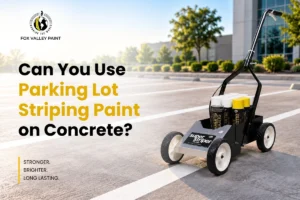
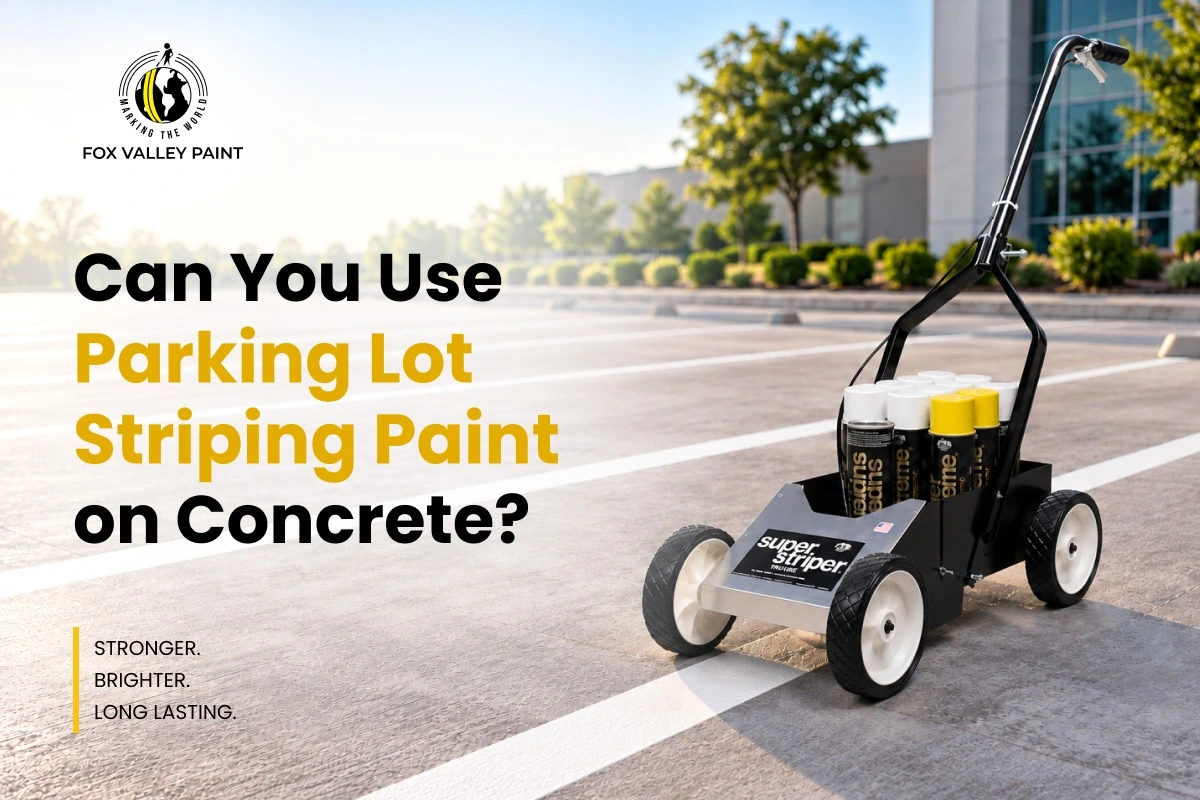
Use a line striping machine for consistent width on every pass. Concrete surface seams and texture variations can deflect freehand spray slightly off-line, so the machine’s fixed height and angle removes that variable entirely.
Allow at least one full hour before vehicle traffic on concrete. Concrete retains moisture longer than asphalt in cooler conditions, which extends cure time. In temperatures below 60°F or in high humidity, extend the no-traffic period to two hours minimum. Check the spray striping paint temperature guide for full guidance before starting any application.
Fox Valley’s professional-grade traffic striping paint bonds to asphalt and concrete in a single pass. Solvent-based formula, fast-drying, UV-resistant, and available in white, yellow, blue, red, and more.
12–24
Months on Asphalt
Standard conditions, moderate traffic, correct application.
12–24
Months on Concrete
Same lifespan when properly prepped and sealer-free.
When applied correctly, quality traffic striping paint lasts 12 to 24 months on concrete, identical to asphalt. The surface material is less important than surface preparation and application conditions. High-traffic concrete surfaces such as parking garage floors or warehouse driveways may need restriping more frequently, annually in most cases, due to constant tire wear across the painted surface. See the full guide on how long parking lot paint lasts for durability expectations by surface type and traffic volume.
The single most common failure on concrete lots. Always do the water bead test before ordering paint. A sealer you cannot see will cause complete paint failure within days.
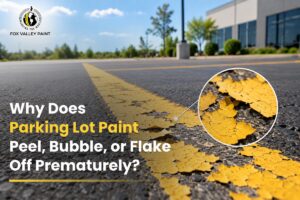
Concrete holds moisture in its pores longer than asphalt. Even after 24 hours, deep moisture can remain. Allow 24 to 48 hours after rain before painting. For causes and fixes of early paint failure see our full guide on why parking lot paint peels.0
White lines on light concrete have poor visibility and low contrast. Yellow provides significantly better visibility and stands out clearly on both concrete and asphalt surfaces.
Because paint does not penetrate concrete as deeply as asphalt, a faster pace can produce faint or thin lines. Slow down slightly and maintain a consistent 12 to 14 inch spray height for full coverage in one coat.
Coverage on concrete can be slightly higher per linear foot than asphalt. Use our parking lot paint calculator to get an accurate can estimate before ordering. Running short mid-job on concrete is a common and avoidable problem.
Fox Valley’s Starter Kit includes a precision line striping machine and professional-grade traffic paint that bonds to concrete and asphalt. One kit covers lots up to 50 spaces. No contractor needed.
Yes. Professional-grade traffic striping paint bonds to concrete just as effectively as asphalt when the surface is properly cleaned, fully cured, and free of existing sealers or coatings.
No primer is needed for bare, clean, fully cured concrete. The only case where a primer helps is on very smooth or polished concrete where the surface has minimal texture for the paint to grip. For standard concrete lots, proper cleaning and degreasing is sufficient.
Yellow provides better visibility on concrete than white. Concrete is light gray, which means white lines have poor contrast against the background. Yellow stands out clearly on both concrete and asphalt and is the recommended choice for concrete parking lots.
Hot water pressure washing, chemical paint strippers, or mechanical grinding are the main options for concrete. Grinding is most effective for thick or old paint buildup. After removal, confirm the surface is fully clean and dry before applying new traffic striping paint.
Yes. A standard line striping machine works on both surfaces without any modification. The only adjustment is a slightly slower walking pace on concrete to ensure full coverage per pass. The machine’s fixed height and angle eliminates the spray deflection that concrete surface seams can cause with freehand application.