
Lining a soccer field correctly ensures player safety, clear boundaries, and a professional-looking playing surface. Whether you are setting up a field for adults, youth leagues, schools, or community parks, knowing the correct dimensions, materials, and technique makes the difference between a professional result and a frustrating do-over. This complete guide explains exactly how to line a soccer field from start to finish using the Athletic Field Starter Kit from Fox Valley Paint, without hiring a contractor.
Having the right equipment ready before you begin saves time and prevents mistakes mid-project. Here is everything you need to line a soccer field:
Using the correct athletic field marking paint is critical. Regular spray paint or traffic paint can burn, suffocate, or permanently damage natural grass and synthetic turf. Fox Valley Paint’s water-based formula is specifically designed to be turf-safe, non-toxic, and safe for players and maintenance crews.
Before placing a single stripe, you need to confirm your field dimensions. Painting lines in the wrong positions means repainting the entire field, which wastes both time and paint.
A standard adult soccer field measures 70 to 75 yards wide and 115 to 120 yards long. These dimensions are recognized across recreational leagues, schools, and community parks. Always verify with your local league or governing body before marking, as specific competitions may have slightly different requirements.
A youth or children’s soccer field typically measures 45 to 55 yards wide and 70 to 80 yards long. These smaller dimensions are designed to suit younger players and are commonly used for recreational leagues, school programs, and community youth sports events.
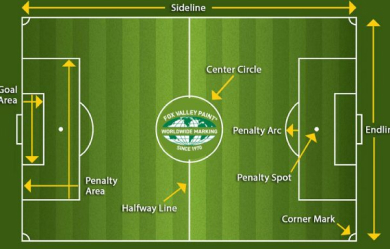
Planning every marking in advance before you start striping ensures accurate placement and prevents the need for corrections later. Refer to the field diagram for exact placement of each marking.
Walk the entire grass area before placing any markers or paint. Check for uneven ground, soft spots, holes, or debris that could interfere with striping. A flat, clear surface produces the best results and ensures your striping machine moves smoothly throughout the process.
Once you have confirmed the surface is ready, use a measuring tape or measuring wheel to mark out the full field dimensions. Start with the four corners of the field and place corner flags or stakes at each point. These markers serve as visual guides and tell you exactly where to stop and turn during striping.
Stretch a string line between corner markers to create a straight reference for your sidelines and endlines. This is one of the most important steps, as even a slight deviation at the start leads to noticeably crooked lines by the time you reach the other end of the field.
With your corner markers in place, measure and mark the positions of all interior field lines before any paint is applied. Use chalk, string lines, or temporary marker spray to indicate the center of the field, the halfway line, the penalty areas, goal areas, penalty spots, and corner marks.
Taking extra time at this planning stage prevents costly mistakes. It is far easier to adjust a chalk mark than to correct a painted line on grass. Walk the full layout once before striping to visually confirm that all measurements are accurate and proportioned correctly.
The Fox Valley Paint walk-behind striping machine is designed for easy setup with no special training required. Follow these setup steps before you begin:
The Fox Valley Paint walk-behind striping machine is designed for easy setup with no special training required. Follow these setup steps before you begin:
Always begin with the outer boundary lines, the sidelines and endlines, before moving to interior markings. This establishes the full perimeter of the field and gives you a clear framework to work within for all remaining lines.
Walk at a slow, steady, and consistent pace as you push the striping machine along your string or chalk guide. Moving too fast produces thin, uneven lines. Stopping and starting mid-line creates visible breaks and inconsistencies. The goal is one smooth, uninterrupted pass for each line.
Keep your eyes focused on the guide line in front of you rather than looking back at the line being painted. Trust the machine to follow your path and maintain your walking pace from start to finish. Allow each line to dry before striping an adjacent or parallel line nearby. Fox Valley Paint’s athletic field marking paint dries in under 10 minutes, so you do not need to wait long between passes.
Once the boundary lines are complete, measure and mark the exact center of the field to establish the halfway line. Stripe the halfway line in one continuous pass from sideline to sideline.
For the center circle, use a string tied to a stake at the center point of the halfway line to create a 10-yard radius guide. Walk the circle carefully with the striping machine or use a stencil for a cleaner result. The center circle must be precise as it is one of the most visible markings on the field and is used at every kickoff.
Measure the penalty area carefully from the center of each goal line. The standard penalty area extends 18 yards from each goalpost and 18 yards into the field. The goal area sits inside the penalty area, extending 6 yards from each post and 6 yards into the field.
Stripe all four sides of each rectangle clearly and evenly. These are high-traffic areas during matches, so applying a second coat in the penalty areas is recommended for high-use fields. Wait for the first coat to fully dry before applying the second coat.
Mark the penalty spot 12 yards from the center of each goal line. Use a small stencil or carefully hand-spray a clearly visible dot at each spot.
For the penalty arc, measure 10 yards from the penalty spot and use a string guide or arc stencil to paint the curved line outside the penalty area. This marking is often missed or done incorrectly, so take extra time to get the radius right.
At each corner of the field, use a corner mark stencil to paint a small quarter-circle arc with a 1-yard radius. These marks indicate where corner kicks are taken from and must be visible and accurate.
Once all markings are complete, walk the entire field and inspect every line. Check for gaps, thin spots, uneven edges, or any markings that need a touch-up. Apply minor touch-ups immediately while you still have paint cans available.
Fox Valley Paint’s athletic field marking paint dries in under 10 minutes, so the field is typically ready for light use within 30 minutes of completing the final markings.
Water-based athletic field marking paint typically lasts 3 to 6 weeks depending on the amount of rainfall, how frequently the field is mowed, and the volume of foot traffic. High-use fields may require touch-ups every 2 to 3 weeks during peak season. Premium paint formulas like Fox Valley Paint’s Super Stripe provide longer-lasting results and maintain brightness through heavy play and weather conditions.
Lining a soccer field is a straightforward process when you have the right equipment, accurate measurements, and a clear step-by-step plan. By using turf-safe athletic field marking paint, setting up your striping machine correctly, and walking at a steady consistent pace, anyone can achieve professional-quality soccer field lines without hiring a contractor. The Fox Valley Paint Athletic Field Starter Kit gives schools, parks, coaches, and facility managers everything they need to line a soccer field accurately and efficiently in a single session.
For questions or to place an order, contact Fox Valley Paint at (844) 627-5255.
Lining a soccer field involves 8 key steps: surveying and measuring the field, planning the full layout, setting up the striping machine, striping the boundary lines first, painting the halfway line and center circle, marking the penalty areas and goal areas, adding penalty spots, arcs and corner marks, and doing a final inspection before opening for play.
A standard adult soccer field is 70 to 75 yards wide and 115 to 120 yards long. For youth or children's soccer fields, the dimensions are typically 45 to 55 yards wide and 70 to 80 yards long. Always verify with your local league before marking as specific competitions may have slightly different requirements.
Always use water-based athletic field marking paint specifically designed for grass and synthetic turf. Regular spray paint or traffic paint can burn, suffocate, or permanently damage the turf. Fox Valley Paint's water-based formula is turf-safe, non-toxic, fast-drying, and safe for players and maintenance crews.
Fox Valley Paint's athletic field marking paint dries to the touch in under 10 minutes. The field is typically ready for light use within 30 minutes of completing all markings. For high-traffic areas like the penalty area, a second coat is recommended after the first coat is fully dry.
Water-based athletic field marking paint typically lasts 3 to 6 weeks depending on rainfall, mowing frequency, and foot traffic volume. High-use fields may require touch-ups every 2 to 3 weeks during peak season. Repainting regularly ensures lines remain visible and the field stays compliant for official play.
Yes. With the right equipment and materials, anyone can line a soccer field without hiring a contractor. The Fox Valley Paint Athletic Field Starter Kit includes 12 cans of water-based athletic field marking paint and a precision walk-behind striping machine, giving you everything you need to achieve professional-quality lines in a single session.