
Managing a multi-use athletic field is a challenge every school, park, and sports facility eventually faces. Football players need yard lines. Soccer teams need sidelines and penalty boxes. Lacrosse players need their crease. When all three share the same grass, chaos can follow unless you have a smart color coding system in place.
This guide will walk you through exactly how to use athletic field marking paint to color-code a multi-sport field so every player, coach, and referee always knows exactly where they stand.
Without a color coding system, overlapping field lines lead to mid-game confusion, officiating errors, and safety hazards. A clearly organized sports field line color guide helps players instantly identify which lines belong to their sport even during warmups when multiple teams share the space.
The system also saves you time and money. Instead of repainting the field before every game, you paint each sport’s lines once with its designated color and they coexist all season long.
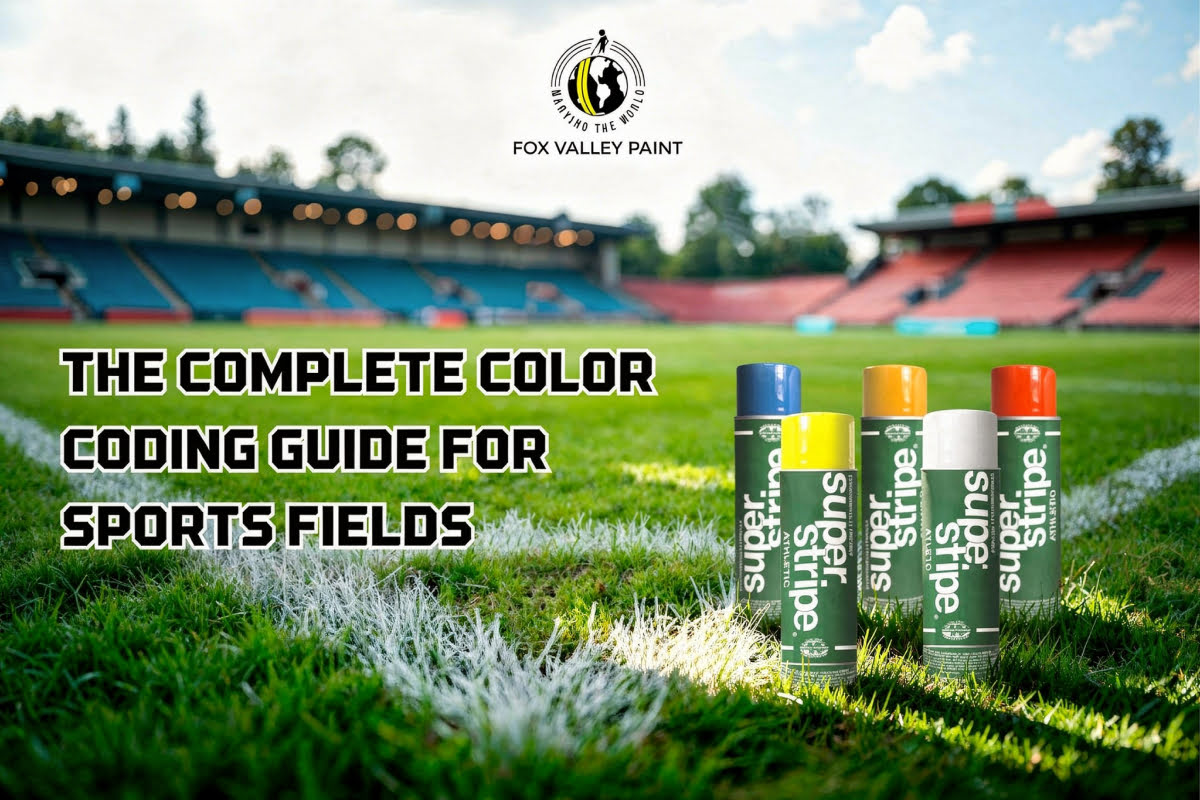
Here is the widely accepted color priority system for multi-use fields:
| Color | Sport | Why This Color |
|---|---|---|
| ⬜ White | Football / Primary Sport | Highest visibility, universally recognized as the main sport |
| 🟡 Yellow | Soccer | Bright contrast against white lines, easy to distinguish |
| 🔵 Blue | Lacrosse | Stands out clearly from white and yellow on green turf |
| 🔴 Red | Field Hockey / Rugby | Bold, high-contrast color for secondary sports |
| 🟠 Orange | Baseball / Softball | Vivid and distinct, works well on natural and synthetic turf |
The rule of thumb: assign white to your most frequently played sport, then work down the color list by usage frequency. This ensures the dominant sport is always the most visible.
Property owners often underestimate the liability exposure of a poorly marked lot. If a driver is injured or causes an accident because markings were unclear, that’s a real legal risk. ADA regulations mandate clearly visible accessible parking spaces faded markings can be cited during inspections. Fresh parking lot striping paint is a small investment that protects against a much larger one.
The same logic applies to athletic fields. Mismarked boundaries in soccer, football, or baseball can trigger disputes, delays, and safety concerns. Coaches, referees, and parents all notice the difference between a professionally marked field and one with faded, uncertain lines.
Before you touch a can of paint, sketch your field and plot all sport dimensions to scale. Identify where lines will overlap and decide which sport gets which color. Free tools like Google Drawings or even graph paper work well for this.
Always paint the primary sport (white) first. This is typically the sport with the most games per season. Let it cure fully most field marking paint dries in under 10 minutes, making same-day multi-sport painting entirely possible.
Work through your sports in priority order, painting each in its assigned color. Use a field striping machine for perfectly straight, consistent lines every time. Freehand painting leads to wavy lines that look unprofessional and can actually confuse players.
Post a simple laminated sign near the field entrance showing which color corresponds to which sport. This takes 10 minutes to make and eliminates confusion for players who are new to the field.
A standard football field (100 yards) typically requires 10–12 cans for a full set of yard lines, hash marks, and end zones. A full soccer field (110 x 70 yards of lines) uses roughly 6–8 cans. For a multi-sport setup painting all lines on a combined field, plan for 20–25 cans across all colors to cover everything properly.
Fox Valley’s 12-can Athletic Striping Paint packs are available in 6 vibrant colors making it easy to stock exactly what you need for each sport on your field.
White is the standard for football since it's typically the primary sport on most school and community fields. It offers the highest contrast and visibility under game lights and during daytime play.
Yes. Fox Valley's athletic field marking paint dries in under 10 minutes, so you can paint all your sports in a single session without colors bleeding or mixing.
Yes, Fox Valley's water-based formula is specifically designed to be safe for natural grass and synthetic turf. It won't kill grass, compact soil, or leave harmful residue for athletes.
Depending on weather and foot traffic, field lines typically last 2–4 weeks before a touch-up is needed. High-traffic zones like center circles and goal areas may need refreshing more frequently.
A striping machine is strongly recommended for multi-sport fields. Hand-spraying leads to uneven widths and wavy lines, which causes exactly the kind of player confusion you're trying to prevent. A machine pays for itself in time and consistency within the first field.