
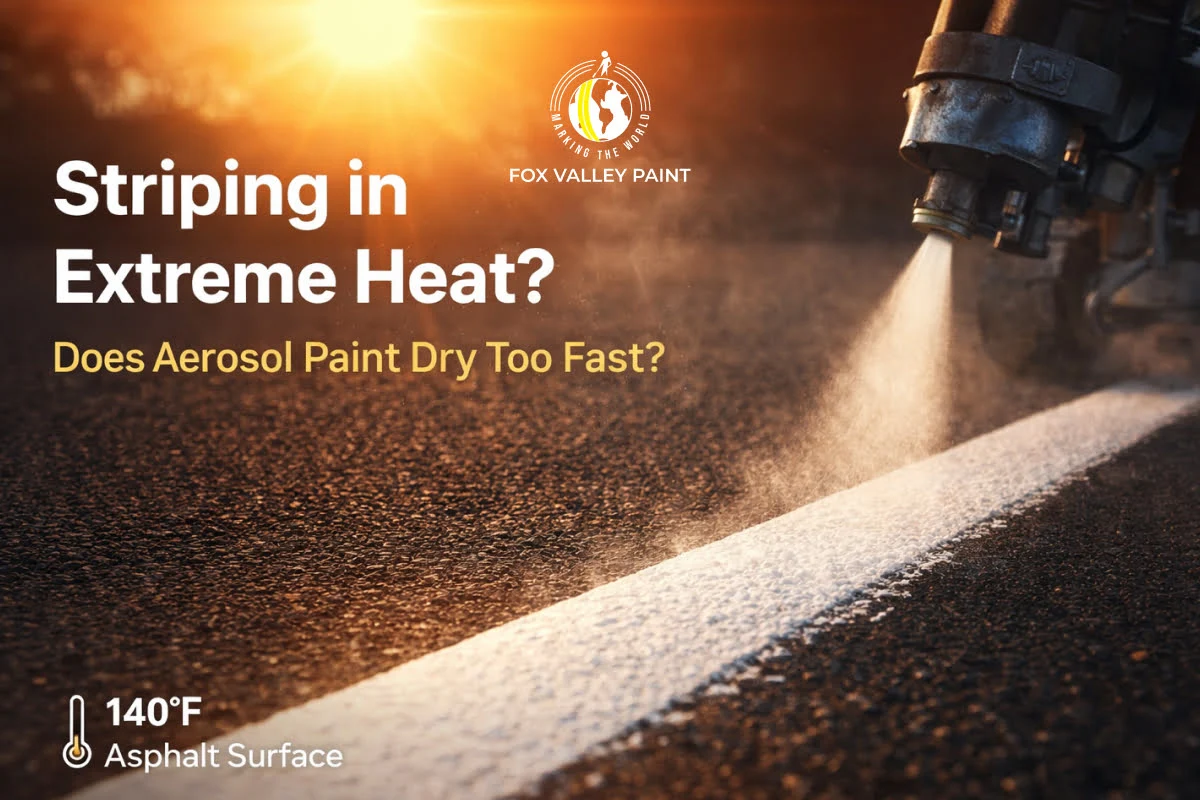
Yes, aerosol striping paint can dry too fast in extreme summer heat, but with the right timing and technique, summer is actually one of the best seasons to stripe a parking lot.
If you’ve ever tried to stripe a parking lot on a blazing July afternoon and ended up with uneven, blotchy lines you’re not alone. Heat is a double-edged sword for aerosol parking lot striping paint. Too much of it, and paint flash-dries before it bonds properly to the asphalt. Too little, and lines stay wet for hours. Here’s exactly what you need to know to get it right.
Traffic marking paint whether water-based acrylic or solvent-based is engineered to cure within a specific temperature window. For most aerosol striping paints, that sweet spot is between 60°F and 85°F (15°C–29°C). Inside this range, paint atomizes cleanly, lands on asphalt evenly, and cures at a rate that allows proper adhesion.
When ambient temperatures climb above 90°F and pavement surface temperatures can reach 140°F+ on a hot summer day the paint begins to “flash dry.” This means the top layer dries before the bottom layer has bonded to the asphalt, resulting in:
Solvent-based aerosol paints are especially vulnerable. In very hot climates, even professional contractors switch to water-based latex during peak summer months because it is more forgiving at high temperatures.
Most municipal codes and the International Parking & Mobility Institute (IPMI) define a standard commercial parking space as 9 feet wide by 18 feet long. The painted boundary lines are typically 4 inches wide, which is the widely accepted industry standard across the U.S.
| Air Temp | Pavement Temp | Condition | Recommendation |
|---|---|---|---|
| Below 50°F | Below 45°F | Avoid | Paint won't cure; stays tacky |
| 50°F – 60°F | 55°F – 70°F | Caution | Longer dry time; plan extra wait |
| 60°F – 85°F | 70°F – 100°F | Ideal | Best results; fast, even dry |
| 85°F – 95°F | 100°F – 120°F | Caution | Work in shade; stripe early morning |
| Above 95°F | Above 130°F | Avoid | Flash drying risk; poor adhesion |
Timing is everything. Professional stripers and experienced DIYers both agree: early morning (6 AM – 9 AM) is the optimal window for DIY parking lot striping in summer. Pavement is still cool from overnight temperatures, humidity is typically lower, and you get clean, fast results before the sun bakes the asphalt.
If morning is not an option, after 6 PM works well in most regions temperatures drop, shadows eliminate direct UV radiation on the surface, and the paint has overnight to fully cure before traffic returns.
Avoid striping between 11 AM and 4 PM on summer days. This is when pavement surface temperatures peak and the risk of flash drying is highest.
Store aerosol cans in a shaded area or cooler not your hot car trunk. An overheated can has excess internal pressure and will spray inconsistently, giving you splatter instead of stripes. Ideal can temperature is between 65°F–80°F before application.
Air temp at 85°F can mean pavement surface at 130°F+. Use an inexpensive infrared thermometer to spot-check asphalt before you start. If the surface reads above 120°F, wait or find shade.
In heat, paint from a stationary can tip will build up and harden almost instantly on contact with hot asphalt. With a striping machine, maintain a consistent walking pace. With a marking pistol, , keep it moving in one smooth, steady pull.
In summer, aerosol nozzles clog faster because residual paint dries in seconds. After each line, briefly invert the can and spray for 2 seconds to clear the valve. This one habit prevents 90% of tip clogs in hot weather.
Water-based acrylic striping paint, is more heat-tolerant than solvent-based formulas. It is also low-VOC, dries cleanly in warm conditions, and is the right choice when temperatures consistently exceed 85°F.
If applied correctly during appropriate temperature windows, parking lot striping paint applied in summer performs just as well and often better than paint applied in cooler months. The heat accelerates the full curing process, meaning lines harden faster and resist tire scuff and early fading.
The durability problem only appears when paint is applied during extreme heat (pavement above 120°F) in that case, the flash-dried surface layer traps moisture underneath, weakening the bond and causing early peeling within weeks.
Bottom line: summer is your friend, as long as you respect the temperature limits.
Fox Valley’s Super Supreme Traffic Spray Paint comes in 7 vibrant colors and is designed for clean, fast-drying stripes on any asphalt or concrete surface even in summer conditions.
Yes, if pavement temperatures exceed 120°F, aerosol parking lot striping paint can flash dry meaning it hardens on the surface before bonding properly underneath. Stripe in early morning or evening to avoid this.
The ideal range is 60°F to 85°F air temperature, with pavement surface temperature below 100°F. This gives you clean, even lines with proper adhesion and a fast dry time of 30–60 minutes.
Fuzzy edges are a classic sign of flash drying caused by hot pavement. The outer edge of paint hits the asphalt and dries before it levels out. Try striping earlier in the day when the surface is cooler, and keep your cans at room temperature before use.
You can, but it is not ideal. Direct sunlight raises both air and pavement temperatures significantly. If you must stripe in sun, work in sections, move quickly, and keep your striping kit in the shade between passes.
In ideal summer conditions (60°F–85°F), aerosol traffic striping paint is dry to the touch in 15–30 minutes and vehicle-safe within 1 hour. Full cure typically completes within 24 hours.