
If you’re repainting a parking lot whether it’s for a small business, church, school, or HOA getting the line widths right isn’t optional. Wrong dimensions mean wasted paint, confused drivers, and in serious cases, federal ADA violations that carry five-figure fines.
This guide breaks down exactly what the standard measurements are for every line type, what ADA law requires, and how to stripe it correctly yourself using the right parking lot striping paint.
Standard parking stall lines are 4 inches wide.
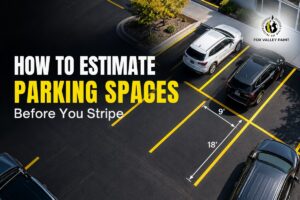
Standard stall size is 9 ft wide × 18 ft long.
ADA accessible spaces must be at least 8 ft (96 inches) wide with a 5 ft access aisle.
Most municipal codes and the International Parking & Mobility Institute (IPMI) define a standard commercial parking space as 9 feet wide by 18 feet long. The painted boundary lines are typically 4 inches wide, which is the widely accepted industry standard across the U.S.
| Line / Space Type Standard Width Notes | Standard Width | Notes |
|---|---|---|
| Stall boundary lines | 4 inchesSport | Most common; suits standard lots |
| Standard parking stall | 9 ft wide × 18 ft long | Commercial industry standard |
| Fire lane lines | 4–6 inches | Often requires yellow + "No Parking" text |
| Crosswalk lines | 6–12 inches | Local codes vary; check your municipality |
| Directional arrows | Varies (12–18 in stencil) | Use stencils for consistency |
Line widths are measured to the centerline of the marking, except for end-of-row spaces which may include the full line width. Always check local codes some cities specify slightly different stall dimensions or line widths than the national standard.
The 2010 ADA Standards for Accessible Design apply to every commercial parking facility in the U.S. If you are restriping or repaving any part of your lot, you are legally required to bring accessible spaces up to current standards. Here’s what the law mandates:
| Space Type | Min. Space Width | Min. Access Aisle |
|---|---|---|
| Standard accessible (car) | 96 in (8 ft) | 60 in (5 ft) |
| Van-accessible — Option 1 | 132 in (11 ft) | 60 in (5 ft) |
| Van-accessible — Option 2 | 96 in (8 ft) | 96 in (8 ft) |
Two accessible spaces can share one access aisle. The aisle must be marked with diagonal lines and must connect directly to an accessible route to the building no steps, curbs, or steep ramps.
For every 6 accessible spaces (or fraction of 6), at least 1 must be van-accessible. Use parking lot stencils for the ISA (wheelchair symbol) and “Van Accessible” sign to stay code-compliant.
Getting the dimensions wrong isn’t just a cosmetic issue. There are three real consequences: legal fines, customer liability, and wasted paint.
DOJ fine first violation
DOJ fine repeat violation
Attorney fees in lawsuits
The Department of Justice can impose civil penalties of up to $75,000 for a first ADA violation, and up to $150,000 for subsequent violations. Private lawsuits from individuals denied access can add attorney fees of $50,000–$200,000 on top of that. These are not theoretical risks ADA parking lawsuits are one of the most common categories of ADA litigation against small businesses.
• Stalls too narrow (under 8 ft for accessible spaces)
• Missing or faded access aisle diagonal markings
• Accessible spaces not on the shortest route to the entrance
• No van-accessible designation
• Slope exceeding 1:48 (2%) in any direction
Even outside ADA, incorrect striping causes real problems. Lines too wide waste paint and reduce your stall count. Lines too thin fade faster and make it hard for drivers to see boundaries clearly increasing fender-benders and parking disputes. Using the wrong paint type (water-based on fresh, unprimed asphalt, for example) causes premature peeling regardless of line width.
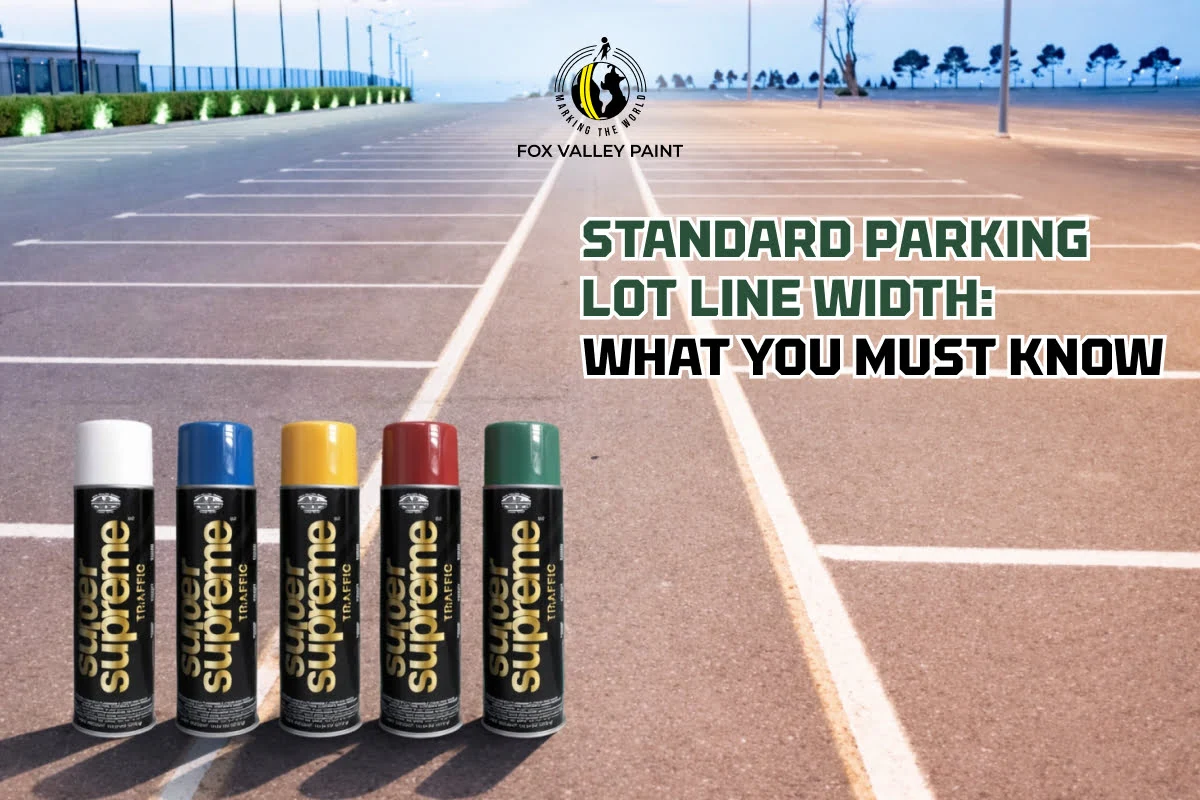
For long-lasting lines on parking lots, solvent-based traffic striping paint is the professional choice. It bonds harder, lasts longer through UV and traffic wear, and gives you a clean, crisp edge every time.
Before you spray a single line, use a chalk line or measuring tape to lay out your stall widths. Standard spacing: mark every 9 feet across the lot. Use a line striping machine set to a 4-inch nozzle width this keeps every line consistent without guesswork. For accessible stalls, measure 96 inches from center-to-center of the lines for the space itself, and then add your 60-inch aisle adjacent to it.
Fox Valley’s Super Supreme Traffic Paint sprays crisp 4-inch lines in 7 vibrant colors. Durable, fast-drying, and built for asphalt. Trusted by property managers and small businesses nationwide.
The industry standard is 4 inches wide for standard stall boundary lines. Some municipalities allow 3–6 inches, but 4 inches is the most widely accepted width for commercial lots across the U.S.
A standard commercial parking stall is 9 feet wide by 18 feet long. Some local codes allow compact spaces at 8.5 ft × 16 ft, but 9×18 is the safest, most universally accepted size.
ADA requires accessible car spaces to be a minimum of 96 inches (8 feet) wide with an adjacent 60-inch access aisle. Van-accessible spaces require either an 11-foot space with a 5-foot aisle, or an 8-foot space with an 8-foot aisle.
For parking lots, solvent-based traffic striping paint is the professional standard. It bonds strongly to asphalt, dries faster, and lasts significantly longer than water-based alternatives under heavy traffic and UV exposure.
Lots with 1–25 spaces need 1 accessible space (must be van-accessible). 26–50 spaces need 2, with 1 van-accessible. The ratio scales up — and for every 6 accessible spaces, at least 1 must be van-accessible.